


Pinealon (Glu-Asp-Arg) is a tripeptide discovered by Vladimir Khavinson’s lab in St. Petersburg over 40 years of bioregulator research.
It doesn’t work like a normal peptide.
Instead of binding cell surface receptors, it penetrates straight through cell and nuclear membranes and binds directly to DNA at specific promoter sequences.
Khavinson’s group identified binding sites across nine gene promoters including:
SOD2
GPX1
PPARA
PPARG
TPH1
Functionally it’s been clinically observed to:
Double SOD2 and GPX1 antioxidant activity in hypoxia-vulnerable brain tissue
Delay inflammatory ERK1/2 signaling
Restore hippocampal spine density by 71% in Alzheimer’s models.
Correct disrupted norepinephrine circadian dynamics in the hypothalamus.
Because it targets PPARA and PPARG directly in muscle tissue and upregulates irisin expression through six binding sites on the FNDC5 gene, it stabilizes mitochondria under metabolic load, promotes fat oxidation, and mimics exercise signaling at the molecular level.
Read that again ☝️
Khavinson’s institute tested this directly on elite Russian rhythmic gymnasts preparing for Olympic competition.
The study (n=20, published through Lesgaft National State University) gave 12 gymnasts Pinealon + Kristagen for 20 days against 8 controls.
Gene expression results were genuinely ABSURD:
PPARA up 2.5x
PPARG up 23x
HSPA1A (heat shock protein 70, your primary cellular stress adaptation marker) up 2.9x.
Recovery heart rate dropped from 83.8 to 74.2 bpm in morning sessions.
Training level scores jumped 23%. Energy provision scores jumped 17%.
Integrated health scores went from 65.0 to 78.1 while the control group actually declined from 63.5 to 52.4.
80% of the peptide group didn’t get sick during a flu epidemic that hit the team.
No adverse effects.
Then there’s the judo study (Lysenko et al. 2012, 10 elite female judokas, masters of sport).
Pinealon only, 15 days, AM dosing.
Physical work capacity increased 34%.
The 2012 London Olympics gold medal team had their telomeres measured by Khavinson’s group. These women were in their twenties at peak physical condition and their telomere length looked like average 40 year olds.
Elite training had aged them 15 to 20 years at the cellular level. After treatment with Pinealon and Epitalon, telomere length normalized back to chronological age. Khavinson’s direct quote: “Athletes at this level are over-exercising, resulting in certain damages. These damages may not play out for many years to come.”
Pinealon is a neuroprotective epigenetic modulator that talks directly to your DNA, almost every gene it targets is clock-controlled, and the performance applications are just starting to surface.
Which means when you take it matters enormously.
Here’s the protocol and timeline:
The Cascade and Timeline
7am: 1mg+ oral Pinealon with real sunrise exposure.

380nm UVA hitting OPN5 in your skin and eyes. 480nm blue hitting OPN4 in your retina. 620-1000nm NIR hitting cytochrome c oxidase in every mitochondrion the sunlight reaches.
380nm UVA hitting OPN5 in your skin and eyes. 480nm blue hitting OPN4 in your retina. 620-1000nm NIR hitting cytochrome c oxidase in every mitochondrion the sunlight reaches.
8am: PGC-1α kicks in and starts driving BMAL1 through ROR receptors.
10am: Peak receptor activity across PPARα and clock gene targets.
12pm: Mitochondrial biogenesis ramps up.
6pm: Peak training window with circadian-aligned muscle clocks.
10-11pm: BMAL1 peaks in human muscle tissue, PER2 at its lowest (maximal clock activity), optimal respiratory capacity.
Morning activation literally prepares you for evening peak performance through circadian alignment. This is a 10-12 hour prep window that you either set up correctly at dawn or you don’t.
PepT1 transporter rhythms favor morning absorption
Your gut has a dedicated tripeptide transporter called PepT1 that handles roughly 70% of dietary protein absorption as di- and tripeptides. It has a circadian rhythm.
shows 2 to 5 fold circadian changes driven by clock-controlled DBP binding at its promoter.
Bile acid mediated PPARα regulation
suppresses PepT1 after feeding. PepT1 is highest during fasting. I
f you’re waking fasted, PepT1 is at or near peak expression before breakfast, maximizing absorption capacity for a tripeptide like Pinealon.
Additional morning advantages:
, lower gastric acid relative to the nocturnal peak at 10pm-2am,
higher hepatic blood flow at approximately 8am
, and lipophilic drugs showing 32 to 52% higher Cmax with morning versus evening dosing.
Your entire GI system is primed for absorption in the morning.
Explaining Your Body’s 24 Hour Clock Loop
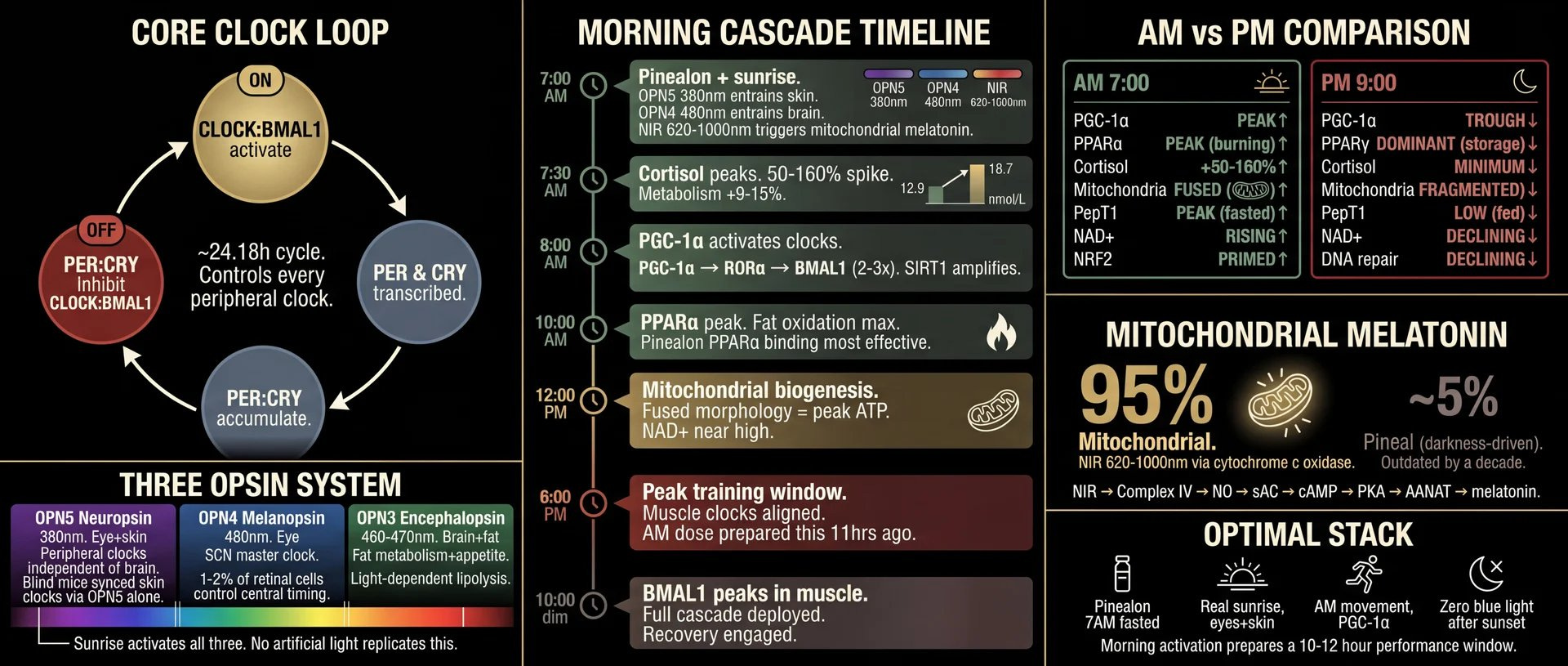
Think of your body like a computer that reboots every morning. The master timer controlling that reboot is a feedback loop between two sets of proteins.
CLOCK and BMAL1 pair up and switch on the PER and CRY genes. PER and CRY proteins then build up, travel back to the nucleus, and shut CLOCK:BMAL1 off.
Every peripheral clock in your body, every tissue, every organ system is downstream of this single loop.
PGC-1α is the morning master switch
PGC-1α is a protein that peaks in the early morning and acts like the ignition key for your entire clock system. Without it, your circadian clocks fall apart.
Liu et al. (Nature, 2007) showed PGC-1α physically grabs onto a receptor called RORα, which then binds to the Bmal1 gene promoter and cranks up BMAL1 and CLOCK expression by 2 to 3 fold.
In plain English: PGC-1α wakes up your master clock genes every morning.
Knock out PGC-1α in mice and they get abnormal activity rhythms, broken body temperature cycling, and messed up clock genes in every tissue.
SIRT1 amplifies this further. by sitting alongside PGC-1α at the Bmal1 promoter, turning the volume up even more.
Morning is when this entire axis is cycling upward. Evening is when it’s approaching trough. You want to dose a clock-modulating peptide into a system that’s powering down? Come on.
PPARα vs PPARγ: morning fat burning vs evening fat storage
Your body runs two competing metabolic programs on a daily schedule. PPARα handles fat burning (oxidation, ketogenesis, energy output). PPARγ handles fat storage (lipogenesis, adipogenesis). They peak at different times.
PPARα mRNA peaks around ZT8-12 in mouse liver, which translates to early morning in humans. PPARα is a direct target of CLOCK:BMAL1, and in Clock mutant mice its expression just disappears.
A chronotherapy study confirmed this matters practically: a PPARα activating drug given at peak PPARα activity produced significantly better reductions in liver fat and blood triglycerides compared to the same drug given at the wrong time of day. PPARγ peaks later and runs the storage program.
Evening dosing is basically asking a fat storage program to handle your neuroprotective peptide. Good luck with that.
Khavinson’s lab confirmed that Pinealon (the EDR tripeptide) has DNA binding sites in both the PPARα and PPARγ gene promoters and upregulates both.
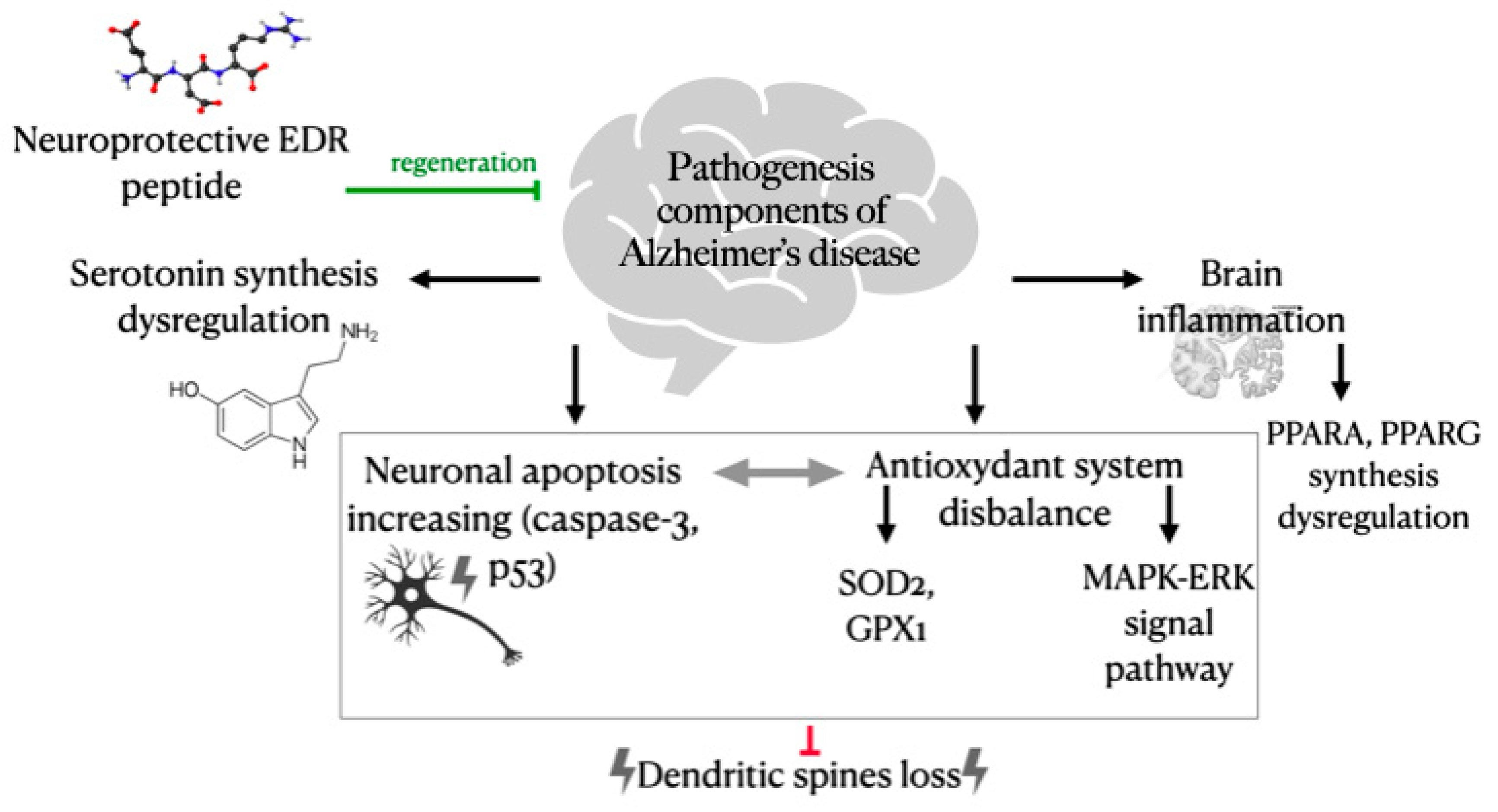
PPARα feeds back onto BMAL1 through its own binding elements, creating a reinforcement loop. Morning administration delivers EDR precisely when this entire axis is actively cycling upward. Everything is connected.
The cortisol awakening response (your body’s natural pre-workout)
Every morning when you wake up, your body fires off a massive cortisol spike. This is called the cortisol awakening response and it’s basically your endogenous pre-workout.
The CAR produces a 50 to 160% spike in cortisol within 30 to 45 minutes of waking, happening in about 77% of healthy adults.
Males peak at roughly 30 minutes post waking, females at roughly 45. Mean waking cortisol sits around 12.9 nmol/L, spikes to 18.7 at peak, with a midnight nadir of just 2.1 nmol/L.
Serum cortisol hits around 399 nmol/L at 08:30 and drops below 50 nmol/L at midnight. Why does this matter for Pinealon?
The CAR drives resting energy expenditure up 9 to 15%, enhances liver amino acid transport, and creates a full system readiness state for processing bioactive compounds.
Your body is literally primed to absorb and utilize exogenous peptides in the morning.
Mitochondrial function peaks in the morning (fused for output, fragmented at night)
Your mitochondria physically change shape throughout the day, and this controls how much energy they can produce.
Schmitt et al. (Cell Metabolism, 2018) showed mitochondrial networks cycle through three states:
During the morning and midday they’re fused and tubular, which is the high performance configuration with peak oxidative phosphorylation and maximum ATP production.
During the transition period they’re intermediate.
At night they fragment, dropping into low OXPHOS and low ATP mode. Think of it like your mitochondria forming a freeway system during the day (efficient, high throughput) and breaking into disconnected side streets at night.
This is controlled by circadian regulation of a protein called DRP1. When researchers genetically removed DRP1, circadian ATP production disappeared entirely.
The fuel for this system is the CLOCK:BMAL1 to NAMPT to NAD+ to SIRT3 axis. Two landmark 2009 papers (Nakahata et al. andRamsey et al., both in Science) showed CLOCK:BMAL1 directly control the expression of NAMPT, the enzyme that makes NAD+.
This produces 24-hour NAD+ oscillations with roughly 2 fold amplitude. NAD+ then activates SIRT3 inside mitochondria, which controls fatty acid oxidation, TCA cycle flux, and respiratory capacity. BMAL1 knockout mice have tanked NAD+, hyperacetylated mitochondrial proteins, and profoundly reduced respiration.
Connecting the Rest of The Light/Circadian/Genetic Dots
If your lifestyle and environment is a circadian war crime, you have no business taking pinealon.
As stated several times already: Pinealon (EDR) binds to clock gene promoters like PPARA, PPARG, SOD2, and GPX1. These are the targets responsible for most of the acute and lasting effects that make this tripeptide the single most impressive bioregulator you can get your hands on.
But those promoter regions have to be OPEN and ACCESSIBLE for EDR to reach them. If your circadian clocks aren’t running properly, the chromatin at those binding sites stays compacted and locked.
What opens those binding sites? Morning sunlight, specifically in the first hour after sunrise.
95% of Your Melatonin Has Nothing to Do With Your Pineal Gland
Suofu et al. published this in PNAS in 2017 and it should have rewritten the entire sleep supplement industry overnight. Your MITOCHONDRIA produce their own melatonin independently of the pineal gland. Venegas et al. (J Pineal Res, 2012) went further and showed that removing the pineal gland actually INCREASED melatonin inside cells. These are two completely independent systems running the same molecule.
One molecule of melatonin neutralizes up to 10 reactive oxygen species, which makes it your most powerful endogenous mitochondrial antioxidant, working the EXACT same defense system that Pinealon’s SOD2 and GPX1 upregulation feeds into.
These are not separate pathways. EDR boosts the enzymatic antioxidants while mitochondrial melatonin handles the free radical scavenging. They are two arms of one system, and the melatonin arm requires near infrared light to function.
The mechanism is clean. Tan, Reiter et al. laid it out in Biology (2023). NIR photons in the 620 to 1000nm range hit cytochrome c oxidase at Complex IV, kick off nitric oxide, trigger a cascade that phosphorylates AANAT, and drive melatonin synthesis right there in the mitochondria.
Female athletes receiving 658nm red light for 14 days had morning melatonin nearly DOUBLE versus controls with their eyes covered, which rules out pineal involvement entirely. Over 50% of solar energy is infrared. LED and CFL lighting emit ZERO near infrared. Modern windows block it as well.
So you are taking a peptide that upgrades half your mitochondrial defense system while starving those same mitochondria of the light signal that runs the other half, it is LITERALLY, not even figuratively putting a turbo on an engine with no oil in it.
Pinealon Needs These Three Opsins Firing
Your body has three separate light sensors that morning sunlight activates simultaneously, and each one gates a different set of tissues that Pinealon is trying to reach.
Melanopsin (OPN4, ~480nm blue) sits in your retina and entrains the SCN master clock, which drives the CLOCK:BMAL1 oscillation that determines whether Pinealon’s PPARA and PPARG promoter targets are actually open and accessible when EDR arrives.
No morning blue light means weak BMAL1 cycling means closed chromatin at exactly the sites the peptide needs to bind. You can take all the Pinealon you want, but if those sites are closed the molecule floats around doing absolutely nothing.
Neuropsin (OPN5, ~380nm UVA/violet) lives in your skin and entrains peripheral tissue clocks independently of your brain.
Buhr and Van Gelder proved this in PNAS (2015) when they showed blind mice with zero working rods, cones, or melanopsin still synchronized their skin clocks through OPN5 alone.
OPN5 knockdown abolishes melanin production from UV in human melanocytes.
Pinealon targets genes in tissues throughout your entire body, not just the brain. Those tissue clocks need OPN5 to stay synchronized with central timing or the peptide lands in desynchronized cells running on their own broken schedule. You need skin exposed at sunrise and there is no way around it.
Encephalopsin (OPN3, ~460-470nm) operates in adipocytes and drives fat oxidation that depends on light in the same metabolic tissues where Pinealon is upregulating PPARA 2.5x and PPARG 23x. OPN3 primes the substrate and EDR turns the gene expression dial. Without the light signal, the dial spins in a dead circuit.
Three opsins, three wavelength ranges, three systems that all have to be running for Pinealon’s gene targets to be accessible when the peptide shows up. Sunrise hits all three simultaneously and nothing else does.
The NAD+/SIRT1 Loop (And Why Every NMN Supplement Bro is Lighting Money on Fire)
This is where light, clock integrity, and gene access all converge into one system.
CLOCK:BMAL1 directly control
NAMPT expression, the rate limiting enzyme that makes NAD+. NAD+ oscillates with2 fold amplitude over 24 hours, and when it rises it activates SIRT1, which deacetylates BMAL1 at Lysine 537 and tags PER2 for degradation at K680.
Both of those steps are necessary for the clock to oscillate with full amplitude.
This system decays with aging as SIRT1 drops in the SCN, circadian period drifts, and adaptation breaks down.
SIRT1 also controls histone H3 deacetylation at the exact E-box containing circadian promoters where Pinealon needs chromatin access to bind DNA.
Low SIRT1 from broken NAD+ rhythms means those promoter regions stay acetylated and closed.
Pinelon PHYSICALLY CANNOT reach its targets in compacted chromatin.
The peptide is there and the binding sites exist but the door is shut because SIRT1 never got the signal to open it.
Morning light entrains the SCN, which drives CLOCK:BMAL1, which drives NAMPT, which drives NAD+, which powers SIRT1, which opens the chromatin Pinealon needs.
Every link in that chain depends on the one before it, and the first link is photons hitting your retina at sunrise.
Morning UV is When DNA Repair Peaks
Cui et al. mapped the UV repair pathway in Cell (2007). UVB damage stabilizes p53, drives POMC production, gets cleaved into alpha-MSH, which binds MC1R on melanocytes and activates melanin production and DNA repair simultaneously.
XPA (the key repair protein) oscillates with circadian rhythm, and BMAL1 regulates its transcription. Peak repair capacity happens in the morning.
Pinealon suppresses caspase-3, the enzyme that executes cell death after DNA damage, and reduces ROS accumulation. So morning light activates your repair machinery at maximum capacity while EDR simultaneously suppresses the damage cascade on the other side.
Take Pinealon at 9pm when repair capacity is bottomed out and the day’s UV damage is already done and you lose the entire repair side of the equation. You get half the benefit for absolutely no reason other than nobody told you this.
Deuterium and the Morning ETC Window
Deuterium is heavy hydrogen at twice the mass, and when it shows up in your ATP synthase it jams the rotor at the Asp61 residue roughly every 15 seconds. Heavy water lengthens circadian period in every organism tested.
Morning is when your mitochondria are fused with peak OXPHOS capacity, producing metabolic water that is maximally depleted of deuterium. That is exactly when Pinealon’s mitochondrial stabilization and SOD2 upregulation has the best possible substrate to work with.
What this Actually Means for You
Pinealon is the GOAT bioregulator and nothing else comes close. No other peptide touches PPARA, PPARG, SOD2, GPX1, and caspase-3 suppression in one tripeptide.
The gene targets it hits, the pathways it modulates, the sheer breadth of what EDR does at the transcriptional level puts it in a category by itself.
if you want to know what Pinealon actually does at full capacity, you have to build the foundation it requires first. Get morning sunlight on your retina and skin within the first hour after sunrise and do it consistently.
Then run your Pinealon protocol and see what happens when EDR reaches its gene targets in synchronized cells where the chromatin is actually open and the circadian machinery is intact.
THAT is the version of this peptide the real biohackers are hyping and the research papers are describing.
Bottom line
Every major circadian mechanism screams morning:
CLOCK:BMAL1 transcriptional activation windows overlap with early morning hours.
PGC-1α peaks and drives BMAL1 through ROR receptors.
PPARα dominant fat burning programs align with morning metabolism.
The cortisol awakening response creates a 50-160% metabolic activation spike within 30-45 minutes of waking.
Mitochondria adopt their high-output fused morphology during the early active phase.
PepT1 absorption capacity peaks fasted. mTOR and BMAL1 mediated translation favor the active phase.
correlating with cortisol (Spearman r = 0.85). NRF2 transcription rises at the rest-to-active transition, priming antioxidant defense.
Pinealon plus real sunrise (Chroma Trinity UVA) at 380nm if you absolutely cannot get outside, but real sunlight is always superior), eyes and skin exposed, zero artificial blue light destroying your opsins after sunset, morning movement to activate the PGC-1α cascade.
If you want to run this protocol yourself, I use and recommend Your Protocol Co's Pinealon. Code BOWTIED gets you 10% off.
As always, if you have any questions, please feel free to ask.
Subscribe and stay tuned for the Deeper Dive and How to Use Pinealon Like Olympic Athletes/ PED Protocol.
Disclaimer: This is educational content based on published research. This is not medical advice. This article is for entertainment and educational purposes only. Consult a physician before making any changes to your health regimen. SWIM and his cohort of orcs, gnomes, and trolls are researchers operating according to in-game rules. We strongly discourage self experimentation without Doctor supervision. Don't be stupid. We may earn a commission from purchases made through the link above at no additional cost to you.
UM - any recommendations on injectable pinealon dose? 1mg/day? I see you recommended oral. But have some injectable
@bowtied
What is the better option..
Option 1
Wake up at 7:00 everyday including weekends.
Turn on the https://getchroma.co/lights for 10min.
Get your fasted cardio in the sun at 8:05am within the 1hour of waking.
Option 2
Wake up at 7:00 and just get the first light at 8:05am
Due to the high trees in my neighborhood, the first morning light hits my area around 8:00am