


Vladimir Khavinson diagnosed something in 1993 that the West is only now beginning to understand.
He called it Premature Aging Syndrome.
Originally documented in pilots, submariners, astronauts, and nuclear reactor workers - people living in artificial light environments, disconnected from natural electromagnetic frequencies - the syndrome now affects the average person.
Why?
Artificial light. nnEMF. Circadian disruption. Pineal destruction.
The same environmental insults that destroy mitochondrial function, suppress melatonin production, and accelerate telomere shortening are now the baseline condition of modern existence.
And here’s what 32 years of Russian research demonstrates: there’s a molecular key that unlocks your DNA’s dormant regenerative programs.
A synthetic tetrapeptide called Epitalon (Ala-Glu-Asp-Gly). What you’re about to read challenges everything the Deep Soy medical establishment has told you about aging.
Let’s get into it.
The Khavinson Framework: What the Russians Understood First
While Western medicine was busy symptom-managing chronic disease, the St. Petersburg Institute of Bioregulation and Gerontology was running 40+ year longitudinal studies on peptide bioregulators.
What they discovered:
Short-chain peptides (2-4 amino acids) act as molecular keys that unlock DNA’s regulatory sequences. They bind complementary to specific nucleotide sequences, transform heterochromatin (inactive DNA) to active euchromatin, and modulate the electron transport chain’s quantum tunneling efficiency at distances up to 20 Angstroms.
Read that again.
Electrons move through protein complexes in ways classical physics says should be impossible - but your mitochondria do it EVERY SINGLE MILLISECOND to keep you alive.
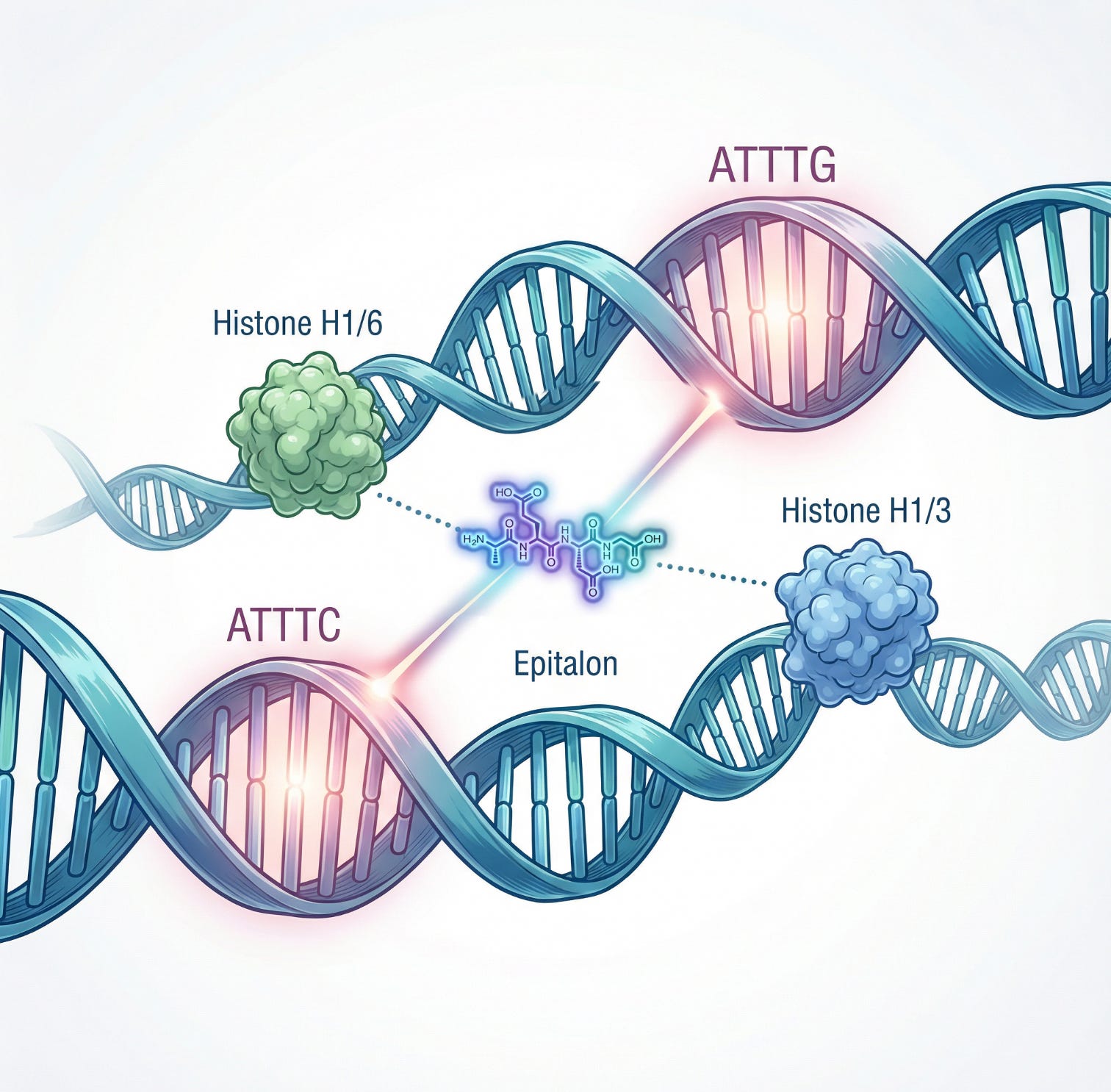
Epitalon specifically binds to ATTTG and ATTTC nucleotide sequences in gene promoters while simultaneously interacting with H1/6 and H1/3 histones at specific DNA-interacting sites. This dual action creates precise epigenetic modifications that CASCADE through your entire mitochondrial network.
Documented, peer-reviewed research spanning three decades. Research the West ignored because you can’t patent a tetrapeptide sequence that nature already uses.
The Melanopsin Connection: Where Everything Clicks
A 2016 study (PMCID: PMC4898879) demonstrated something critical about melanopsin - the photoreceptor in your retinal ganglion cells that connects light exposure to your circadian clock:
Blue light (470nm) causes behavioral arousal, elevating corticosterone and DELAYING sleep onset.
Green light (530nm) produces RAPID sleep induction.
In melanopsin-deficient mice, these responses were completely altered - enhanced sleep response to blue light, but DELAYED sleep induction from green or white light.
What does this mean?
Your ability to sleep when you’re supposed to sleep and wake when you’re supposed to wake is directly controlled by melanopsin function in your retina.
Damaged melanopsin = sleepy during the day + can’t sleep at night.
The cascade that follows:
Leptin resistance - perpetual cravings - fat gain
Insulin resistance
Chronically catabolic state - unable to repair or regenerate
Constant aging and degeneration
Everything is connected.
Now here’s the part that made me lose my mind when I connected these dots:
Epitalon REGENERATES the retina and restores melanopsin function.
A clinical trial (PMID: 12195242) on 162 patients with retinitis pigmentosa - ages 18-72 - demonstrated that Epitalon therapy resulted in:
Improved visual acuity
Expanded visual field
Reduced scotomas
90% positive clinical effect rate
The study concluded that Epitalon “participates in the mechanisms of transcription common for the epiphysis (pineal gland) and retina.”
The pineal gland and retina share the same developmental origin. Both derived from the same neuroectoderm tissue. Epitalon restores the quantum biological machinery that connects light perception to your entire hormonal cascade.
This is why Khavinson’s research matters.
The Five Mechanisms of Action: Why Epitalon Works
1. Epigenetic Regulation via Histone Binding
Khavinson et al. (2020) demonstrated that Epitalon preferentially binds to H1/6 and H1/3 histones at specific DNA-interacting sites (His-Pro-Ser-Tyr-Met-Ala-His-Pro-Ala-Arg-Lys and Tyr-Arg-Lys-Thr-Gln).
Result: 1.6-1.8 fold increase in transcription of neuronal differentiation genes:
Nestin (neurofilament protein)
GAP43 (growth-associated protein 43)
β Tubulin III
Doublecortin
Epitalon acts as an epigenetic regulator - it modulates gene expression WITHOUT altering DNA sequence. This explains its broad spectrum of biological activities across different tissue types.
Implication: Your DNA already contains the programs for regeneration. Epitalon unlocks them.
2. Telomerase Activation and Telomere Elongation
Khavinson & Bondarev (2003) demonstrated that Epitalon induces telomerase activity and telomere elongation in human somatic cells - particularly in telomerase-negative cells.
The numbers are staggering:
4-fold increase in telomerase activity in normal fibroblasts (IBR.3)
26-fold increase in normal mammary epithelial cells (HMEC)
Two mechanisms: telomerase upregulation + Alternative Lengthening of Telomeres (ALT) activation
Telomere shortening is a hallmark of cellular aging. Every time your cells divide, telomeres shorten. When they get too short, cells enter senescence or apoptosis.
Epitalon’s ability to activate telomerase in somatic cells represents a direct intervention in the aging process at the chromosomal level.
Longer telomeres correlate with improved mitochondrial function through the PGC-1α pathway - the same pathway activated by morning sun exposure and cold thermogenesis.
Everything is connected.
3. Pineal Gland and Melatonin Regulation
Djeridane et al. (2003) showed that Epitalon normalizes melatonin secretion by the pineal gland in both young and aged rats, restoring circadian rhythm function.
But here’s what most people miss:
Mitochondria produce 95% of your body’s melatonin. Only 5% comes from the pineal gland.
When you truly understand this, the systemic effects of Epitalon make perfect sense. Restoring mitochondrial melatonin production throughout your entire body.
Melatonin in mitochondria:
Controls apoptosis (programmed cell death)
Protects melanin via the NRF2 pathway
Cools the body during the dark cycle
Helps form Exclusion Zone water (crucial for hydration and regeneration)
The 1.6-fold increase in urinary melatonin metabolite seen with Epitalon treatment addresses sleep AND restores the quantum timing mechanism that one-third of your mitochondrial proteins depend on.
4. Clock Gene Modulation
Clinical studies showed Epitalon modulates circadian clock genes:
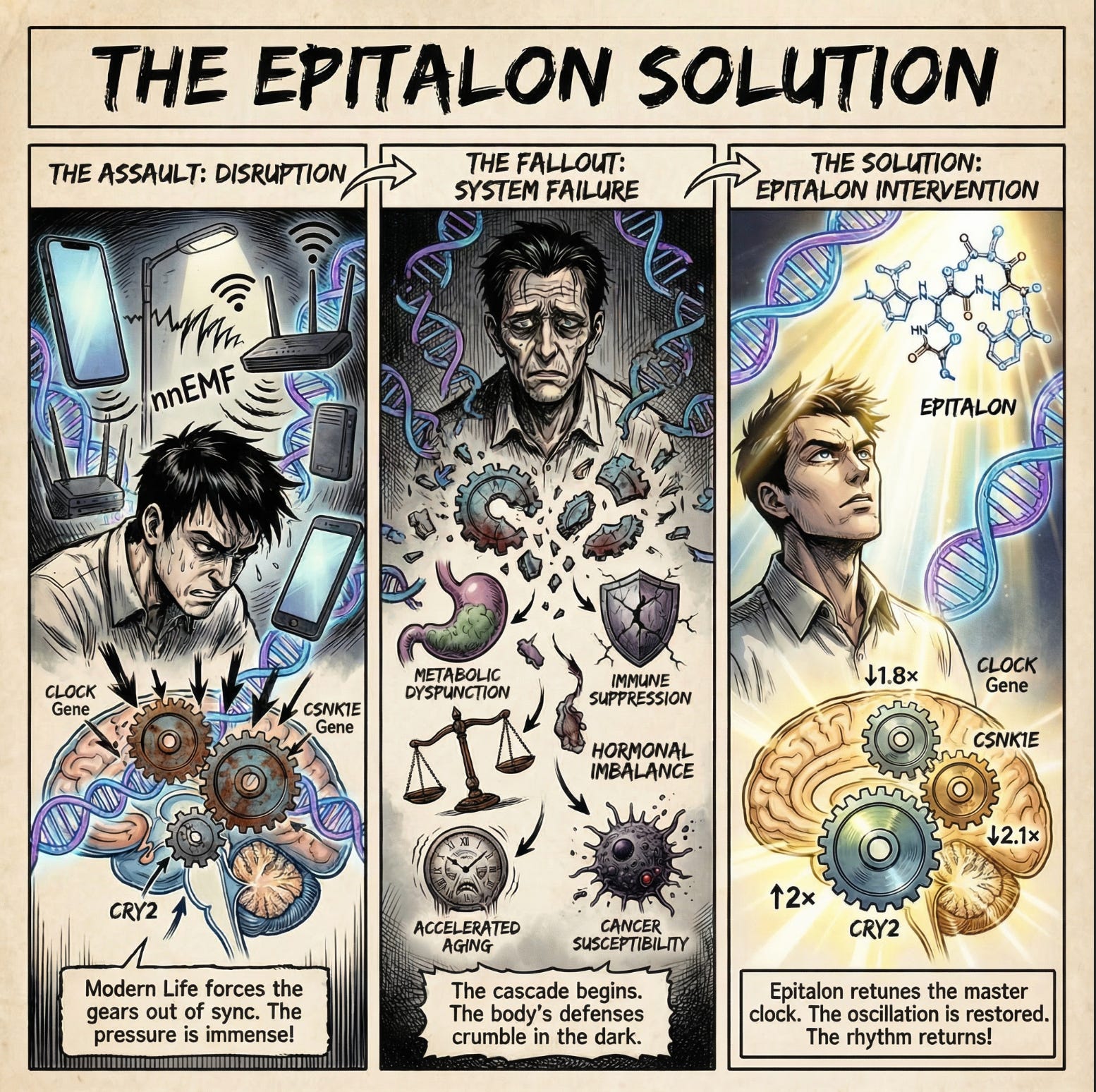
Clock ↓1.8×
Cry2 ↑2×
Csnk1e ↓2.1×
Direct modulation of the molecular machinery that governs your 24-hour rhythms.
When these genes are disrupted by artificial light and nnEMF, the cascade effects include:
Metabolic dysfunction
Immune suppression
Hormonal imbalance
Accelerated aging
Cancer susceptibility
Epitalon restores the proper oscillation patterns.
5. Neurogenic Differentiation
Khavinson et al. (2020) demonstrated that Epitalon induces neuronal cell differentiation in:
Retinal stem cells
Human periodontal ligament stem cells (hPDLSCs)
Human gingival mesenchymal stem cells (hGMSCs)
Therapeutic implications:
Neurodegenerative diseases (Alzheimer’s, Parkinson’s, Huntington’s)
Brain injury recovery
Age-related cognitive decline
Retinal degeneration
Your body maintains stem cell populations throughout life. The problem? The environmental signals to differentiate them into functional neurons have been suppressed.
Epitalon restores those signals.
The Anti-Cancer Evidence: 35 Years of Data
This is where the Deep Soy establishment really doesn’t want you looking.
Colon Cancer Prevention
Anisimov et al. (2002) demonstrated significant reduction in colon cancer incidence in a chemically-induced rat model. Epitalon was effective during BOTH initiation and promotion stages of carcinogenesis, with dose-dependent protective effects.
Cited by 41 publications.
Breast Cancer Inhibition
Anisimov et al. (2002) showed 80-90% reduction in mammary tumor development in HER-2/neu transgenic mice - a model for genetically predisposed breast cancer.
Cited by 74 publications.
Anisimov (2003) documented that pineal peptide preparations are “potent inhibitors of mammary carcinogenesis in rodents” through restoration of pineal gland function.
Cited by 114 publications.
General Tumor Suppression
Kossoy et al. (2006) demonstrated preventive effects on spontaneous tumorigenesis in mice - reduced total tumor incidence, particularly effective against malignant neoplasms.
Anisimov & Khavinson (2009) summarized 35 years of accumulated research: Epitalon suppressed development of spontaneous and induced tumors in male rats under various lighting conditions.
Mechanisms of Anti-Cancer Action
Normalization of neuroendocrine regulation - restoration of pineal function affects cancer susceptibility
Melatonin-mediated effects - increased melatonin has direct anti-cancer properties
Cell cycle regulation - influences proliferation and apoptosis
Immune modulation - enhanced immune surveillance against cancer cells
Epigenetic modulation - altered gene expression in cancer-prone tissues
The consistent finding across all these studies: Epitalon extended lifespan while simultaneously reducing cancer incidence.
This is the opposite of what you’d expect from a telomerase activator. The mechanism matters more than the simple “telomeres = longevity” narrative.
Human Clinical Trials: 15 Years of Follow-Up
The Landmark Longitudinal Study
Korkushko, Khavinson, Shatilo (2011) - “Peptide geroprotector from pineal gland slows accelerated aging in elderly people: results of 15-year observation”
Study Design:
Duration: 15 years
Population: Elderly patients with cardiovascular disease
Intervention: Periodic administration of epithalamin (natural pineal extract containing epitalon)
Control: Standard therapy alone
Results:
28% reduction in mortality in epithalamin group compared to control
Decreased functional age
Reduced degree of aging acceleration
Improved cardiovascular outcomes
Cited by 27 publications.
One of the longest human clinical trials of ANY geroprotective intervention, demonstrating sustained benefit over a decade and a half.
Circadian Rhythm Restoration in Humans
Korkushko et al. (2004) studied circadian rhythm of plasma melatonin concentrations before and after epithalamin treatment in elderly subjects.
Results:
Restoration of normal melatonin rhythms
Improved sleep quality
Enhanced daytime alertness
Cited by 18 publications.
The Mortality Numbers
Let me make this crystal clear:
28% decrease in overall mortality
2-fold decrease in cardiovascular mortality
1.6-1.8 fold reduction in mortality over 6 years (separate study)
These aren’t marginal effects. This addresses cellular aging at the quantum biological level.
Safety Profile: 32 Years of Data
Across all studies - animal and human - Epitalon demonstrates:
No significant adverse effects
No influence on food consumption or body weight
No increase in cancer incidence (actually decreased)
Well-tolerated in human clinical trials spanning 15 years
No organ toxicity
No nephrotoxicity - actually PROTECTIVE in rhabdomyolysis and cisplatin-induced kidney injury
No genotoxic effects
Ultra-low effective doses: In Drosophila studies, effective doses were 16,000-80,000,000 times LOWER than melatonin.
This safety profile is remarkable for any compound with such profound biological effects.
